
CALL OR TEXT US NOW
630-426-0196

When Does Gambling Constitute Asset Dissipation?
 Divorce can be difficult, especially when one spouse’s financial choices hurt the couple’s shared property. Gambling is a common example of this problem. When a spouse uses marital money for gambling instead of household or family needs, it can affect how the court divides property.
If you believe your spouse’s gambling has drained your joint finances, your attorney can help you find records, analyze spending, and show how that behavior affected your financial situation. Working with experienced Schaumburg, IL divorce lawyers ensures that wasted money is properly considered in your case.
How Illinois Law Defines Asset Dissipation
Illinois law gives judges the power to divide property in a fair and reasonable way. Under 750 ILCS 5/503(d)(2), courts can look at whether either spouse used marital property for their own benefit for purposes unrelated to the marriage. This includes gambling, drug use, or spending money on an affair.
The timing matters. A few gambling trips years before the divorce may not count. However, repeated or high-stakes gambling while the marriage is breaking down can be strong proof of dissipation.
Establishing Intent and Recklessness To Prove Asset Dissipation in an Illinois Divorce
Judges look for intent in dissipation cases. To prove that gambling counts as asset dissipation, you must show that your spouse acted with intent or reckless disregard for your shared finances. Courts look at several warning signs, including:
-
Excessive gambling: Repeatedly risking large sums of money or gambling beyond typical, casual entertainment levels
-
Knowledge of financial obligations: Continuing to gamble while knowing about unpaid bills or overdue mortgage payments
-
Awareness of divorce proceedings: Gambling heavily after learning a divorce is likely or has already been filed
Each of these factors helps show that a spouse made careless or intentional choices that damaged the couple’s finances.
How Does Gambling Affect Marital Assets?
Gambling can directly damage a couple’s financial stability. Losing money through casinos, online betting, or sports wagering reduces what is left for both spouses to share in a divorce. In some cases, gambling can even be used to hide money. For example, a spouse might claim gambling losses to explain missing funds that were actually transferred elsewhere. Even if the gambling is real, the result is the same.
Can Gambling Debts Be Divided in a Divorce?
Under 750 ILCS 5/503(a), debts acquired during a marriage are usually shared between spouses. However, gambling debts are treated differently. If the gambling did not benefit the family or was done without the other spouse’s knowledge, those debts may belong only to the gambler.
For example, if your spouse took out credit cards or loans to gamble secretly, the court could assign that debt to them alone. On the other hand, if both spouses occasionally gambled together for fun and agreed on the spending, it might be considered a shared expense. The judge will review each situation carefully to decide what is fair.
How To Gather Evidence of Gambling Losses
You need solid proof to show that gambling caused financial harm. Courts will not rely on suspicion alone. Your lawyer can help gather evidence through a process called financial discovery, which requires both sides to share records and documents. Helpful evidence can include:
-
Bank and credit card statements
-
ATM withdrawals from casinos
-
Sports betting or online gambling records
-
Tax forms showing gambling winnings or losses
A forensic accountant can help trace where the money went. These financial experts review bank records, transactions, and spending patterns to uncover how funds were used or hidden. Under Illinois Supreme Court Rule 214, you can request these records through your attorney to make sure all relevant information is available to the court.
Can You Recover Money That Was Lost Through Gambling?
You may not be able to recover the exact amount of money that your spouse gambled away, but Illinois courts can make up for the loss in other ways. If the judge finds proof of dissipation, they can award you a larger share of what remains. For instance, if your spouse lost $15,000 through gambling, the judge might give you an extra $15,000 worth of assets.
The court’s goal is fairness, not punishment. However, if your spouse lied about gambling or hid transactions, the judge can take stronger steps. This could include ordering repayment or considering that behavior when deciding issues like spousal maintenance or attorney’s fees.
What If Your Spouse’s Gambling Is Linked to Addiction During Divorce?
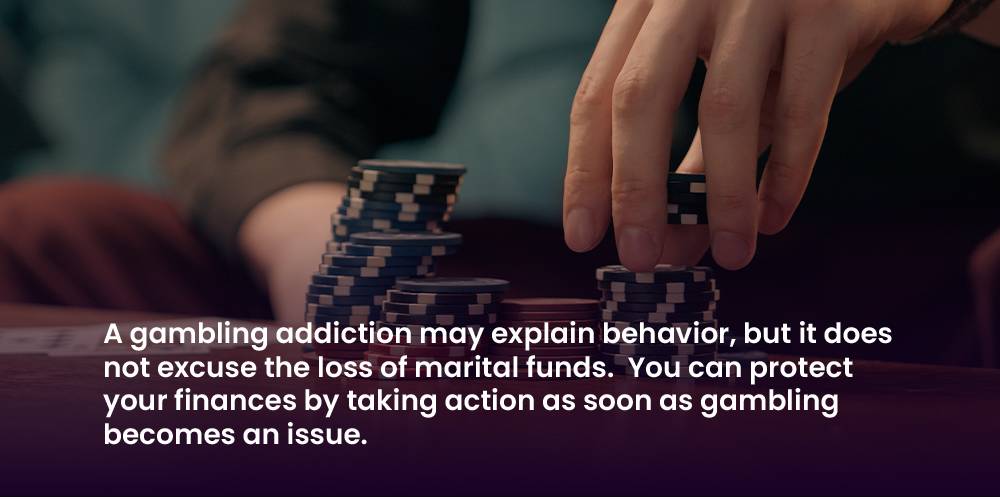
A gambling addiction can be both emotional and financial. While addiction can explain a person’s behavior, it does not excuse the waste of marital assets. Judges focus on the financial loss, not only on the reason behind it.
If your spouse’s addiction caused major losses, your attorney can ask the court to consider those facts when dividing assets or debts. Counseling and treatment may help your spouse personally, but they do not change the need to protect your financial future during divorce.
How To Protect Yourself if Your Spouse Gambles During Divorce
If your spouse continues gambling after you file for divorce, take steps to protect your finances. These actions can help you avoid more loss and keep your money safe:
-
Open a separate bank account: Deposit your income in an account under your name only.
-
Close or freeze joint credit cards: This prevents your spouse from using them to accumulate new gambling debt.
-
Track all financial activity: Keep copies of your bank statements and monitor transactions closely.
-
Notify your attorney: Tell your lawyer right away if you see large withdrawals or suspicious spending.
-
Ask the court for protection: Under 750 ILCS 5/501, your attorney can request temporary financial orders that stop either spouse from transferring or hiding marital funds.
Taking these steps early helps maintain stability while your divorce is pending.
Contact Our Experienced Schaumburg, IL Divorce Attorney Today
If your spouse has been gambling away marital funds, you have to act quickly. A knowledgeable lawyer can help determine whether the spending counts as asset dissipation and how to recover what was lost.
At A. Traub & Associates, our Schaumburg, IL divorce lawyers are committed to our clients and approach every case with communication, collaboration, and compassion. We believe in open dialogue, teamwork, and protecting each client’s long-term financial well-being. Call 630-426-0196 today to schedule a consultation and learn how we can help you.
Work with Our Team
& Get Started Today
To get in contact with a member of our team, call or text us at 630-426-0196
or fill out and submit the contact form below.
 The use of the Internet or this form for communication with the firm or any individual member of the firm does not establish an attorney-client relationship. Confidential or time-sensitive information should not be sent through this form.
I have read and understand the Disclaimer and Privacy Policy.
Lombard
200 W. 22nd Street, Suite 210
Lombard, IL 60148
P 630-426-0196
MAP + DIRECTIONS
Arlington Heights
634 S. Arthur Avenue
Arlington Heights, IL 60005
P 847-749-4182
MAP + DIRECTIONS

LEAVE US A REVIEW
200 W. 22nd Street, Suite 210
Lombard, IL 60148





Apply Now!
Please submit your resume in PDF format via e-mail: hello@atclaw.com.
Your application should include your resume and a cover letter. Our team reviews all submissions from potential candidates, and we will respond to your email as quickly as possible. If you have any questions about the position or the submission of your resume, please send us an email using the link above.
